

Back to BlogOTHER ARTICLES
Why IT Support Costs More Than You Think (and What You’re Really Paying For)
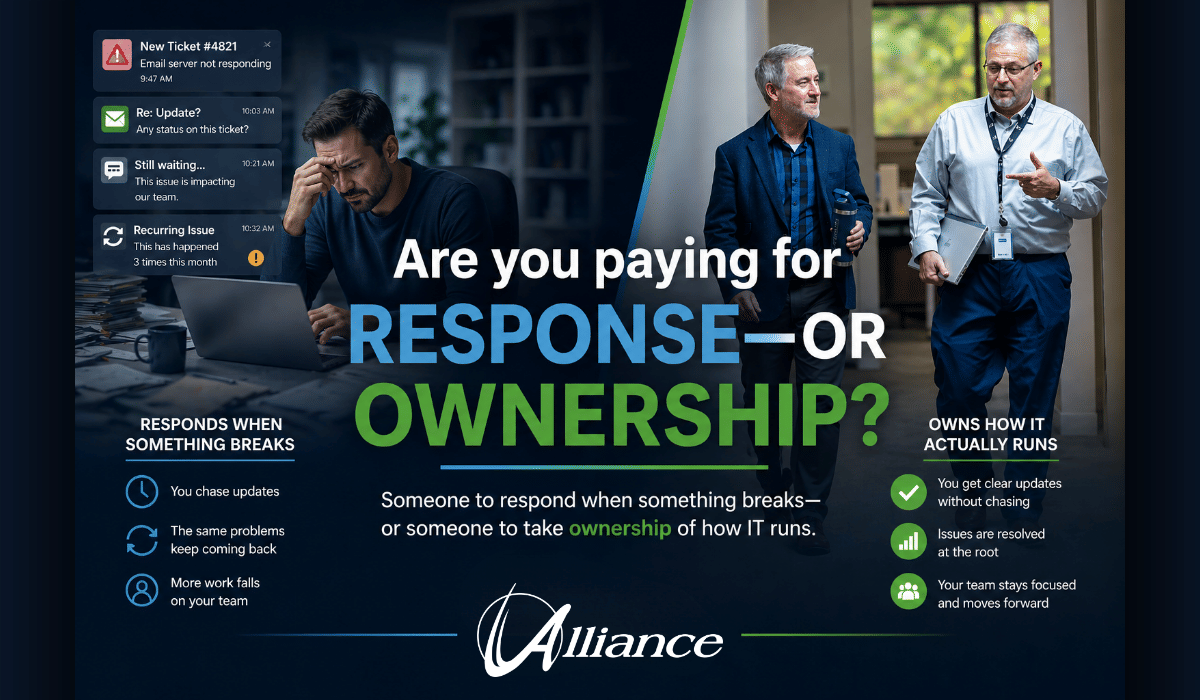
IT support might look similar on paper—until you have to rely on it
If you’re comparing providers, you’ve probably noticed how similar they sound.
They offer the same core services. They talk about responsiveness, support, and strong service. On paper, it can be hard to tell the difference.
The gap shows up once you start depending on them.
That’s when you find out whether issues are actually getting resolved or just moved along. Whether your team still has to follow up to keep things moving. Whether the same problems keep coming back, or if someone is taking the time to fix what’s underneath.
That’s also where the price difference starts to make more sense.
Because at that point, you’re no longer comparing services—you’re seeing how much responsibility stays on your team versus how much is actually being taken off your plate.
What you’re really deciding between
Most providers can respond when something breaks. That’s not the hard part.
The real difference is what happens after that first response, and how much of the outcome they actually own.
In lower-cost models, the work often centers around handling what comes in. A ticket is opened, someone responds, the issue is addressed, and the system moves on. On paper, it looks efficient. But in practice, it can leave gaps. Issues get passed between people, context gets lost, and progress depends more on the client than it should.
We hear this a lot when companies come to us: a ticket gets opened, someone responds quickly, and then it gets passed around internally. By the time it’s actually resolved, the client has had to follow up multiple times, re-explain the issue, or work around it just to keep things moving. On paper, it looks like support is working. In reality, the business is carrying the gap.
Over time, that creates a pattern that is easy to overlook but hard to ignore once you feel it. Your team follows up more than expected. Problems resurface. Communication requires effort instead of providing clarity. And when something larger needs attention, it does not move unless someone internally keeps it moving.
Lower cost often means less continuity, less ownership on them, and more responsibility staying with your team.
A higher-value partner is built differently. The expectation is not just to respond, but to carry the work forward, resolve it fully, and reduce the chance that it comes back again.
What you should expect if you’re paying for better IT
If you’re going to invest more, the difference should be obvious—not just in how quickly someone replies, but in how little your team has to think about IT in the first place.
Here’s what that looks like in practice.
1. You shouldn’t have to manage your IT provider to get things done
A quick response is fine, but it doesn’t mean much if nothing moves after that.
In a lot of environments, the first reply is treated as the win. The ticket gets acknowledged, maybe passed along, and then it sits until someone follows up.
You shouldn’t have to keep asking for updates, reminding people what’s still open, or wondering if something got dropped. If something matters to your business, it should already be tracked, prioritized, and moving forward without you pushing it.
Most of our clients don’t come to us because their IT is broken—they come because they’re tired of carrying it.
That’s where the difference shows up. At Alliance, the expectation goes beyond responding. We take ownership. The goal isn’t to make the numbers look good, but, rather, to make sure things actually get handled. Open items don’t just sit there. They’re owned, moved forward, and closed out in a way that doesn’t leave you guessing.
You’re not just getting a response—you’re getting follow-through.
2. You should see fewer repeat issues over time
If the same problems keep coming back, that’s not just bad luck—it’s a sign that no one is really fixing what’s underneath.
A lot of providers handle what’s in front of them, close the ticket, and move on. It’s efficient in the moment, but it creates a loop where the same issues keep showing up.
That’s where things start to wear on your team.
A better approach is to treat repeat issues as a signal. If something happens more than once, it gets looked at differently. What’s causing it? Has it happened before? What needs to change so it doesn’t keep happening?
At Alliance, that’s just how the team thinks. No one likes seeing the same issue come back, so they dig in. If it’s something bigger, it gets pulled into a deeper review with more experienced people involved. The goal isn’t to patch it—it’s to fix it in a way that holds.
Over time, that’s what reduces noise in your business.
3. You should be working with people who actually know your business
Technical skill matters, but context is what makes it useful.
If your provider doesn’t really know your environment or how your business operates, every issue takes longer. Every recommendation has more guesswork behind it. And every interaction starts from scratch.
That’s exhausting over time.
You want a team that knows how your systems are set up, how your people work, and what actually matters to your business. That way, when something comes up, they’re not figuring everything out from zero—they’re building on what they already know.
This is where Alliance clients usually feel a big shift. They’re not constantly reintroducing themselves or re-explaining how things work. The team already has that context, and they use it.
It makes everything faster, and more importantly, more consistent.
4. You should never wonder what’s going on
One of the most common frustrations with IT isn’t that nothing is happening, it’s that you don’t know what’s happening.
That gap creates a lot of unnecessary follow-up. Even if work is moving, it doesn’t feel like it is.
Better communication fixes that.
You should know what’s being worked on, what still needs attention, and what’s coming next without having to chase it down. Not in a way that floods you with detail, but in a way that keeps you informed enough to stay confident.
At Alliance, communication is treated as part of the work, not an extra step. The team not only stays aligned internally, they also keep the right people in the loop so things don’t get lost or go quiet.
That changes how the relationship feels. You’re not managing information—you’re receiving it in a way that helps you make decisions.
5. Your provider should be finding things before they become problems
A reactive model waits for something to break. That might be something small, like a pattern of minor tickets that point to a larger issue, or something bigger, like a gap in maintenance or compliance that hasn’t caused a problem yet—but will.
A stronger model pays attention before that happens.
That means noticing gaps, spotting patterns, and bringing things forward before they turn into bigger issues. It also means helping you understand what matters and what doesn’t, so you’re not guessing where to focus.
A lot of lower-cost providers aren’t built for that. They’re built to handle what comes in, which keeps things simple but puts more responsibility on you to identify what needs attention.
At Alliance, the expectation is different. The team is always looking for what could cause issues down the line or what could be improved. Then they bring it forward with context so you can make a clear decision.
You’re not left trying to connect the dots yourself.
6. When something goes wrong, you should feel the difference immediately
Every provider looks fine when things are quiet. The real test is what happens when something actually goes wrong. That’s when process matters less and people matter more.
In many environments, even when support is responsive, the client still ends up coordinating. You’re the one asking what’s happening, figuring out who’s involved, and trying to piece together whether anything is actually being resolved.
That’s where things start to feel heavy, especially when the stakes are high.
A stronger model looks different. With Alliance, from the moment something starts to go wrong, the right people are already stepping in. The issue is being worked, not just acknowledged. Communication starts early, not after the fact. And instead of you trying to pull a team together, you’re being kept informed while the team handles it.
In some cases, you may not even be the first to notice—because we’ve already caught it.
That’s not about being reactive—it’s about paying attention, knowing the environment well enough to spot problems early, and taking ownership quickly enough that the situation never turns into a scramble.
7. You should feel like your IT partner actually cares whether your business succeeds
Processes matter. Documentation matters. Communication matters. But none of those things mean much if the people behind them are only trying to move work through a system. The real difference shows up when your provider cares enough to stay with the problem, ask better questions, look for what’s being missed, and think beyond the immediate request.
That’s a major part of how Alliance works. Our team doesn’t want to keep seeing the same problems come back any more than you do. We don’t want your people frustrated, your leaders chasing answers, or your business slowed down by issues that should have been handled differently. We also don’t measure success simply by closed tickets—we measure it by whether your business runs better. Ultimately, we care about the work because we care about your business.
For many clients, this is the part that’s hardest to compare in a proposal but easiest to feel once the relationship starts. You’re not working with just any support desk. You’re working with people who know you, know your environment, and want your business to succeed.
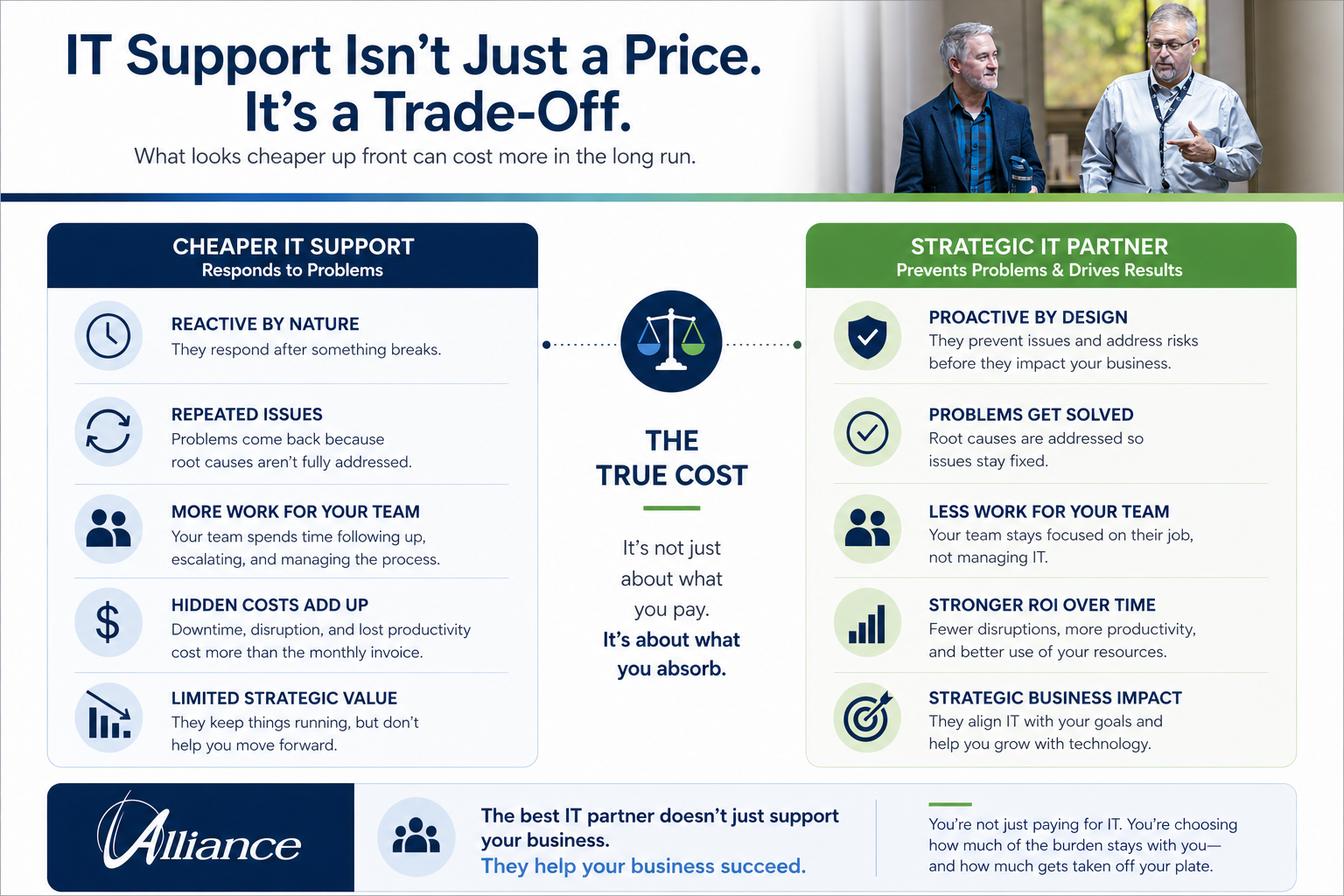
The real question is not whether you can find cheaper IT support
You probably can.
But when you step back, the price difference usually comes down to this:
Are you paying for someone to respond when something breaks, or are you paying for someone to take ownership of how IT actually runs in your business?
Those are two very different models.
One keeps costs lower, but leaves more on your side.
The other costs more, but removes more from your plate.
With Alliance, that burden shifts to us. Work moves forward without being chased. Problems are addressed more completely. Communication is clearer. And your team spends less time dealing with IT and more time focused on their actual roles.
That is what you are really paying for: people who know your business, care about the outcome, and take enough ownership that your team can focus on their actual work.
So the question is not, “Why does this provider cost more?”
The better question is, “What am I still responsible for if I choose the cheaper option?”
If you’re weighing your options right now
Instead of just comparing price, it’s worth asking a different set of questions.
- How much follow-up is still happening on your side?
- How often do the same issues come back?
- How clear is your visibility into what’s being worked on?
- How much of your team’s time is tied up in things that should already be handled?
Those answers will tell you more than any proposal will.