Why IT Maturity Matters More Than the Technology You Use
Picture this: you’re in a meeting about a new initiative. Maybe a system upgrade, a new process, or expanding into another location. The idea makes sense. The opportunity is there. But before anyone can move forward, the conversation shifts.
Someone asks how the new system will connect with the current tools. Someone else isn’t sure where the data actually lives. The IT team needs time to investigate how everything fits together.
The room goes quiet while people start figuring things out.
Nothing is broken. But no one has a clear answer yet.
You’ve probably noticed that some companies move through moments like this quickly. They launch initiatives faster, integrate systems more easily, and make technology decisions with confidence.
Others, sometimes with similar teams and similar tools, move more cautiously.
The difference usually isn’t the technology itself.
More often, it comes down to how well the business understands its own technology environment.
When you have clear visibility into how systems support the business, decisions move quickly. When that visibility is limited, even capable teams slow down.
Most businesses don’t realize which side of that line they’re on, and until that becomes clear, technology decisions tend to feel slower, heavier, and more uncertain than they should.
So let’s break down what actually separates a “good enough” IT environment from one that’s truly built for growth—and how leaders like you start gaining the clarity needed to move faster.
The Real Difference Between Stable IT and Growth-Ready IT
A few patterns consistently separate technology environments that simply function from those that support growth:
- Visibility drives speed. When leadership understands how systems support the business, decisions move faster and initiatives stall less often.
- Structure reduces risk. Clear ownership, documentation, and governance prevent small issues from becoming operational problems.
- Roadmaps replace reaction. Mature environments evolve intentionally instead of changing only when something breaks.
- Alignment removes friction. Technology supports business strategy instead of forcing the business to adapt around it.
Companies that move fastest rarely have perfect systems.
They simply understand their environment well enough to make confident decisions. That level of clarity is what separates organizations that can execute quickly from those that spend months untangling technology questions before a project can even begin.
How Technology Environments Lose Clarity
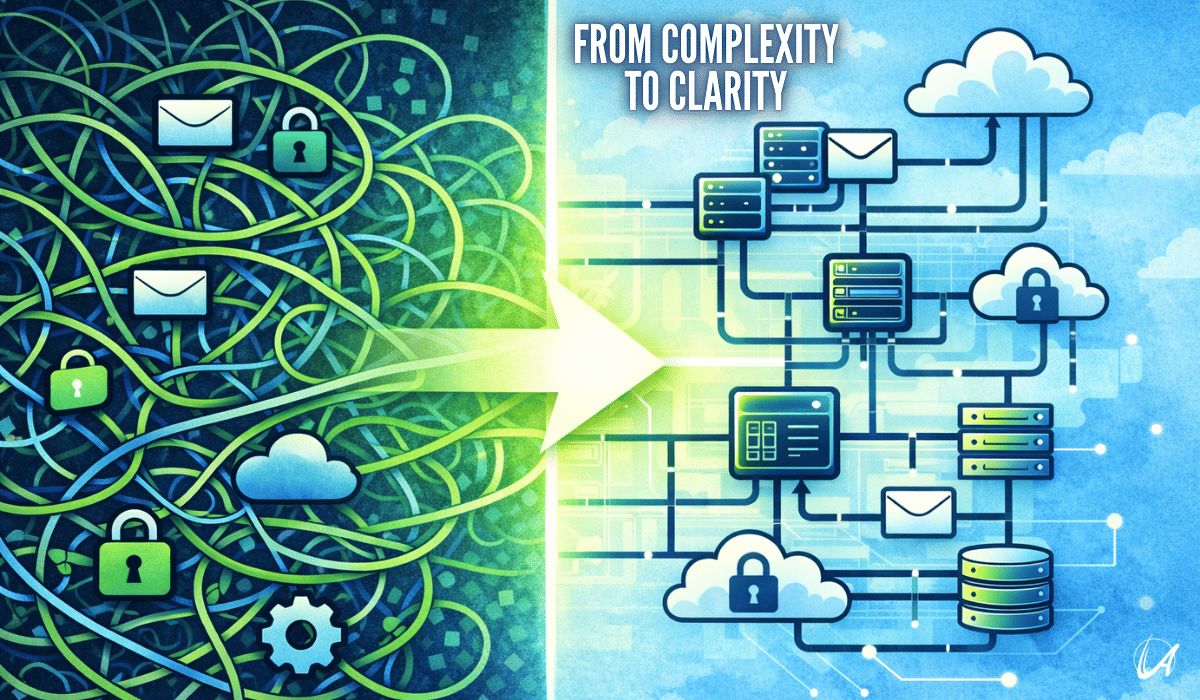
Most technology environments don’t become complicated overnight. They evolve piece by piece as the company grows: a new system is introduced to solve a specific problem; a vendor is selected during a time-sensitive project; a department adopts a tool that improves its workflow. And each of those decisions makes sense at the time.
Over time, though, those decisions begin to layer on top of each other. Systems connect in ways no one originally planned. Documentation falls behind. Dependencies become visible only when a project forces people to investigate.
From the outside, everything still appears stable. But inside, it becomes harder to answer simple questions:
At those moments, stability is assumed. Structure is scrutinized.
- What technology improvements should we prioritize next?
- Where are the real risks in the environment?
- Which systems matter most to the business?
- What should our technology look like two or three years from now?
Without clear answers, your organization begins paying an execution tax. Every initiative takes longer because teams must first rediscover how the environment actually works. Not because your employees lack skill, but because the environment itself isn’t fully visible.
What a Mature Technology Environment Actually Looks Like
Technology maturity isn’t about having the newest tools or the most complex systems. At its core, it’s about clarity.
In mature environments, teams understand how systems connect, what the real risks are, and which technology investments will actually move the business forward. Because that visibility exists, projects start with execution instead of investigation, and decisions happen with far less hesitation.
Just as importantly, leadership and IT share the same understanding of how technology supports the business. Decisions follow a direction instead of reacting to problems, and leaders spend far less time pulled into operational discussions about how systems work.
When that alignment exists, technology stops being a constant question mark and starts functioning as a reliable foundation for progress. It moves IT from cost center to competitive advantage.
Why We Focus on Maturity Instead of Technology
Most IT conversations start with products, platforms, or vendors. But those discussions rarely answer the question business leaders actually care about:
Is our technology environment structured well enough to support where the business is going?
That’s why we focus on maturity first.
Over the years, we’ve worked with organizations at every stage—companies with a single internal IT leader, teams managing complex infrastructure, and businesses that have relied on the same systems for more than a decade. The environments look different on the surface, but the underlying challenges are often the same.
One of the most common things we hear from leadership teams is: “Our IT works fine, but we’re not sure it will scale with the next phase of the business.” They don’t have a clear view of how everything fits together. And when you’re missing that clear view, technology decisions happen in isolation instead of as part of a roadmap. Important improvements remain stuck in a backlog because no one has stepped back to prioritize them.
When Alliance evaluates an environment, we’re not starting with tools or vendors. We start by mapping how technology supports the business because that determines whether growth will create momentum or friction.
We want to know:
- How visible are risks to leadership?
- How structured are decision processes around technology?
- How easily can the environment adapt when the business grows?
Those answers tell us far more than a list of tools ever could.
Our Role Is to Help Leaders See the Whole Picture
Many organizations already have capable IT teams. What they often lack is the time and external perspective needed to step back and evaluate the entire environment objectively.
We want to help you connect technology decisions to business outcomes.
Instead of focusing only on day-to-day operations, we help organizations understand:
- Where their current environment sits on the maturity curve
- What risks may appear as the business grows
- Which improvements will actually create momentum
Sometimes the right move is modernization. Sometimes it’s better documentation. Sometimes the environment simply needs clearer structure around how decisions are made.
The point isn’t to introduce change for the sake of change. It’s to ensure technology is aligned with the direction of the business. When that alignment exists, progress becomes much easier, projects move forward without unnecessary friction, and leaders spend less time untangling operational questions.
Technology becomes something the business can rely on instead of constantly evaluating.
That shift—from uncertainty to clarity—is often the real milestone in reaching technology maturity. Because clarity is what turns technology from something the business manages into something the business can move with.
Most companies don't realize where they actually sit on the maturity curve until they step back and evaluate the full environment.
If you want a clearer picture of where your environment stands today, we can help.