The Risk Isn’t That Your IT Is Broken. It’s That It Wasn’t Built to Change.
Most companies believe they have “good IT” because nothing is broken.
Systems are stable. Support is responsive. Security tools are in place.
From the outside, that stability looks like maturity.
In reality, it often reflects something far more basic: maintenance.
Maintenance is not the same thing as competitive advantage.
There is a difference between technology that functions reliably and technology that is structured to support growth, integration, and transition. One preserves how the business operates today. The other prepares it for how it may need to operate tomorrow.
That difference rarely appears during routine operations. Day to day, both environments can seem equally stable. Tickets are resolved. Updates are applied. Work continues uninterrupted.
The distinction becomes visible during change.
When a new location opens. When an acquisition closes. When leadership transitions. When systems must integrate quickly and cleanly. In those moments, technology either supports momentum—or quietly slows it.
Environments built primarily for maintenance absorb change through workarounds, undocumented knowledge, and reactive adjustments. Nothing breaks outright, but complexity compounds. Timelines stretch. Dependencies surface. Risk becomes harder to measure.
Environments built with governance in mind behave differently. Ownership is defined. Documentation is current. Change is evaluated for downstream impact. Integration is planned rather than improvised.
Both may look stable on the surface.
But only one is structured to move forward.
When Support Becomes a Cost Center
Most IT support models are designed to maintain stability, not to create advantage.
They focus on:
- Keeping systems online
- Responding to incidents
- Applying updates
- Managing devices and infrastructure
- Meeting response-time targets
This work is necessary. It’s also inherently reactive.
In this model, action begins after something happens. Issues are addressed. Requests are fulfilled. Vulnerabilities are patched.
Over time, technology becomes something you fund to preserve what already exists.
That spend protects uptime. It does not necessarily:
- Reduce integration timelines during acquisition
- Limit disruption when operational responsibility transfers
- Improve onboarding speed for new teams
- Prevent new dependencies from quietly forming
In this environment, IT functions as a cost center—even when it’s performing well.
This is where the distinction between a vendor and a partner becomes clear.
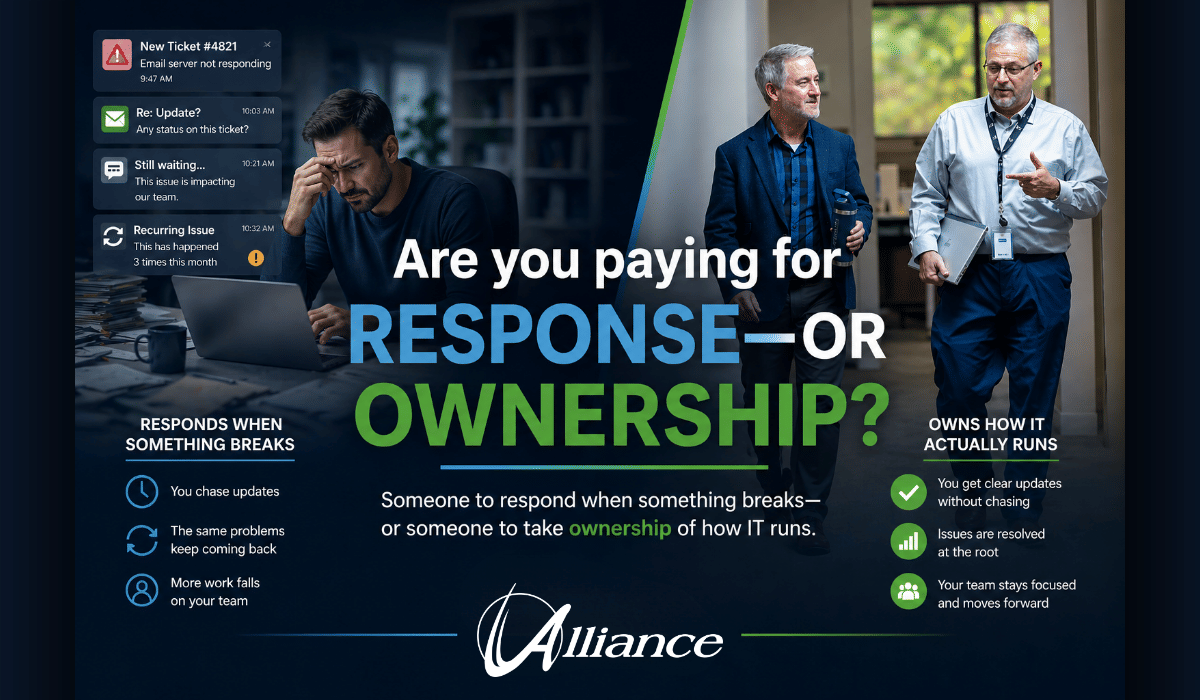
A vendor executes requests and maintains systems.
A partner evaluates how those requests affect scalability, documentation standards, integration timelines, and long-term risk.
The difference isn’t responsiveness. It’s ownership of outcomes.
A Practical Maturity Model for Technology Oversight
Across many organizations, technology environments tend to evolve through predictable stages:
Reactive Support
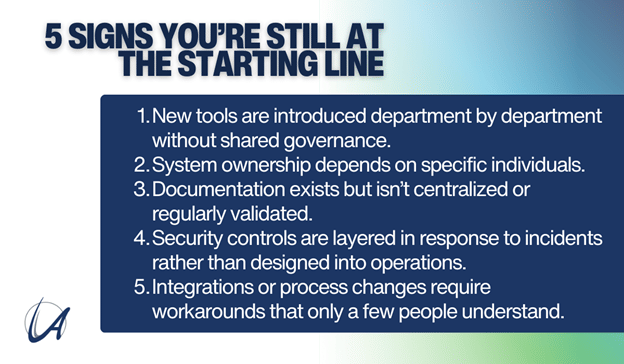
Issues are resolved as they arise. Documentation is limited. System knowledge lives with individuals.
Stable Operations
Systems are monitored and maintained. Support is predictable. Updates are applied consistently.
Most managed services relationships are designed to achieve this level.
It’s necessary, but it’s not strategic.
Governed Infrastructure
Administrative ownership is defined. Documentation is centralized and validated. Security controls are verified. Technology risk is understood in operational terms.
Strategic Enablement
Technology decisions are evaluated based on their impact on scalability, timelines, and capital allocation. Roadmaps align to business priorities. Risk is discussed in financial and operational terms.
This level is built on defined change control, documented ownership, and measurable service standards.
The shift from Stable Operations to Governed Infrastructure is where technology stops being maintained and starts being directed.
We’ve seen acquisition integrations extend by 60-90 days when administrative ownership and documentation weren’t defined in advance. In governed environments, transitions occur in weeks, not quarters.
That difference is structural, not accidental.
How Technology Governance Influences Enterprise Value
Technology environments are routinely evaluated during due diligence, succession planning, and capital events.
At those moments, stability is assumed. Structure is scrutinized.
Is ownership clearly defined?
Is documentation current?
Can operational responsibility transfer without disruption?
✓ Transferable infrastructure reduces key-person risk.
✓ Defined governance shortens transition timelines.
✓ Standardized architecture allows growth without parallel reinvestment.
These outcomes do not result from responsive support alone.
They are the product of structured oversight applied consistently over time.
What a Strategic Technology Partnership Actually Looks Like
Strategic oversight changes the questions leadership asks.
Instead of asking:
→ Can we make this work today?
The conversation becomes:
→ Will this still work when we onboard another team?
→ Will this increase reliance on undocumented knowledge?
→ Does this support our documentation standards?
→ Will this affect onboarding timelines or integration risk later?
When organizations partner with Alliance, governance is not an add-on to support. It is embedded in how environments are structured and reviewed.
That means:
- Quarterly alignment between leadership priorities and technology roadmaps
- Documentation standards that reduce key-person dependency
- Mapping technology risk to operational and financial impact
- Evaluating new tools against scalability and governance criteria
- Maintaining environments that can transfer without disruption
The result is not just stable systems, but an environment designed to scale, integrate, and transfer without unnecessary friction.
That is the difference between a service vendor and a strategic partner.
What a Strategic Technology Partnership Actually Looks Like
“Stable” doesn’t create competitive edge. It’s the baseline. Most companies can achieve that.
The separation begins after that.
When technology is governed intentionally, growth is smoother, transitions are cleaner, and integration moves faster. When it isn’t, complexity compounds quietly until change forces it into view.
If you’re ready to pull ahead, stability isn’t good enough for you. You don’t need more support. You need a partner.
Ready to build beyond stability?
Evaluate your environment with the IT Maturity Self-Assessment.