

Key Takeaways
- Organizations often mistake operational problems for technology problems.
- Many companies asking about AI are really trying to improve visibility, efficiency, and accountability.
- AI often exposes weak processes, poor data, and unclear ownership instead of fixing them.
- The right question isn't "How should we use AI?" It's "What business problem are we trying to solve?"
Everybody seems to be asking the same question right now: “How should we be using AI?”
It's understandable. AI is everywhere. Every software vendor has an AI feature. Every conference has sessions dedicated to AI. Every business publication is discussing its potential impact on the future of work.
As we talk with business leaders across construction, engineering, manufacturing, and other operationally complex industries, we've noticed a common pattern.
The organizations that get the most value from new technology rarely start with the technology itself. They start with the business problem: What isn't working today? Where are teams losing time? What decisions are taking too long? What would a better outcome actually look like? Those questions often reveal challenges that have existed long before AI entered the conversation.
Many organizations are dealing with limited visibility into operations, inconsistent processes, communication gaps between departments, reporting that doesn't support decision-making, or growing complexity as the business expands. AI may be able to help address some of those challenges, but it doesn't automatically solve them.
In fact, one of the most common mistakes we see is organizations focusing on the technology before they have clearly defined the problem they're trying to solve.
When that happens, new tools are often layered onto existing processes without addressing the underlying issues that are creating friction in the first place. Adoption struggles. Expectations aren't met. The technology becomes another disconnected system that delivers far less value than expected.
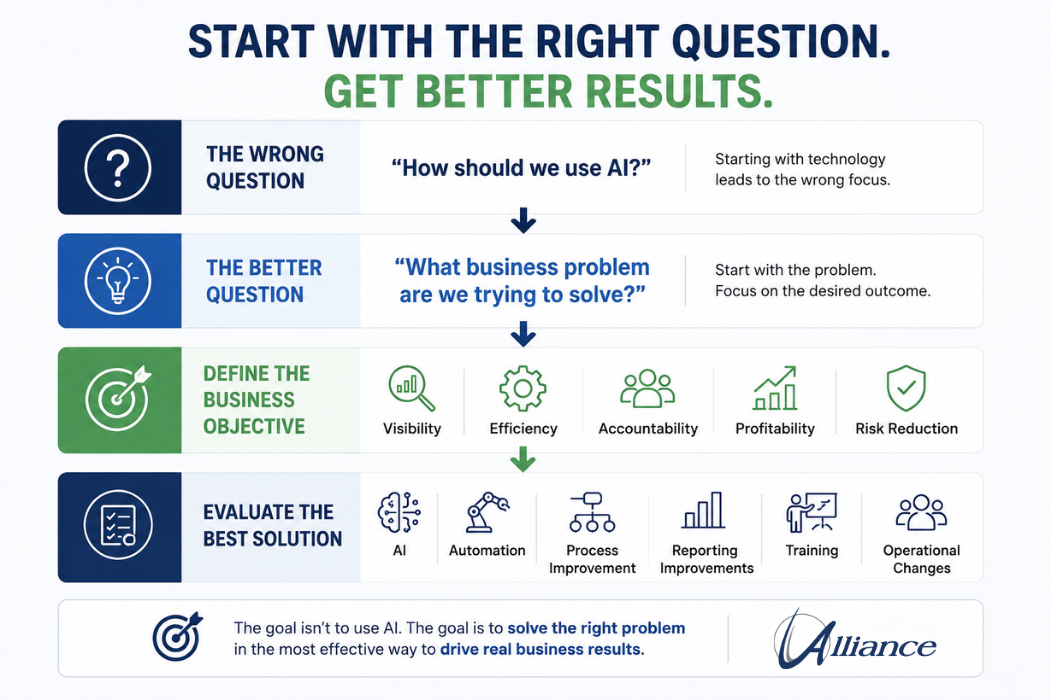
The organizations seeing meaningful results from AI, automation, and other emerging technologies are taking a different approach. They start by defining the outcome they want to achieve. Then they evaluate whether technology can help them get there more effectively.
The sequence matters. Business outcomes come first. Technology comes second. That's where the conversation should begin.
Why Technology Initiatives May Fail to Deliver Expected Value
Many technology projects struggle because organizations are trying to solve the wrong problem.
A manufacturing company recently began evaluating AI because leadership wants better reporting and forecasting. As our conversations progressed, it became clear that different departments define key metrics differently, information is entered inconsistently, and no one owns the reporting process from end to end. The reporting challenge feels like a technology issue, but the real obstacle is operational consistency.
We see similar patterns in construction and engineering firms. A company may come to us looking for workflow automation, only to discover that every team follows a different version of the same process. Another may be evaluating a new platform because project information is difficult to find, when the larger issue is that documentation lives in emails, spreadsheets, shared drives, and individual desktops.
These situations are frustrating because the technology often works exactly as expected. What it exposes are process gaps, ownership issues, inconsistent data, and fragmented workflows that have existed for years.
From what we’ve seen, it’s the organizations with clear processes, strong ownership, and reliable data that usually see better results from the same technology investments. Their teams spend less time working around problems, leadership has more confidence in the information they're using, and new technology is easier to implement. The difference is rarely the tool. It's the foundation behind it.
Business-First Technology Adoption in Practice
The most successful technology initiatives usually start with a clearly defined operational challenge.
We've seen this firsthand in the construction industry. One firm we worked with was managing projects across multiple locations, and every project manager documented information differently. Critical details were spread across emails, spreadsheets, shared drives, and project management systems. Leadership initially wanted to explore AI because employees were spending too much time searching for information.
At first glance, it looked like an AI initiative. In reality, it was a visibility initiative.
Once the organization established clearer standards around documentation and information management, AI became far more valuable. Employees could find information faster, administrative effort decreased, and the technology was able to support a clearly defined business objective.
We've seen similar patterns in manufacturing organizations where maintenance knowledge exists primarily in the heads of a few long-tenured employees. Leadership may initially focus on IoT sensors or predictive maintenance tools. Often, the larger challenge is creating consistent methods for capturing, sharing, and maintaining operational knowledge. Once that challenge is addressed, the technology becomes significantly more effective.
In both cases, the technology succeeds because it supports a clearly defined business objective rather than attempting to compensate for an underlying operational problem.
The Difference Between Following Trends and Solving Problems
One of the easiest mistakes organizations can make is allowing technology conversations to become disconnected from business priorities.
When leaders start with technology, discussions often revolve around features, products, and possibilities. When leaders start with business challenges, the conversation changes. The focus shifts to operational visibility, efficiency, profitability, scalability, risk reduction, and growth.
That distinction matters because every technology investment competes with other business priorities. So the better question is not whether AI can help, but whether AI is the highest-value improvement available today.
If inaccurate reporting is limiting decision-making, improving visibility may create more value than implementing AI. If operational bottlenecks are slowing project delivery, process improvements may generate greater returns. If fragmented information is creating inefficiencies across the organization, solving that issue may deserve priority before introducing additional technology.
AI can create measurable ROI in areas such as knowledge management, workflow automation, proposal generation, reporting, analytics, and administrative efficiency. It can also become a distraction when the underlying issue lies elsewhere.
Organizations don't need an AI strategy simply because AI exists. They need business objectives first. Then they can evaluate whether AI is the right tool to help achieve them.
The Real Question Leaders Should Be Asking
The question you should be asking isn’t “How should we use AI?” The question is: “What business problem are we trying to solve, and is AI the best tool to help solve it?”
The organizations seeing the strongest results from AI start with the outcome, not the technology. They define the problem first, then decide whether AI belongs in the solution.
Many organizations believe they have a technology problem when what they really have is a visibility, process, or accountability problem. The companies creating the most value from AI are the ones that recognize the difference.
Schedule a Mission Audit
Considering AI, automation, IoT, or other modernization initiatives? Let's start with the business outcomes you're trying to achieve.
Schedule a Mission Audit with Alliance Technologies to discuss your priorities, evaluate opportunities, and identify where technology can create the greatest impact for your organization.